TL;DR: Stanford’s AI Index 2026 isn’t just a technology report — read through an L&D lens, it’s a capability report. Entry-level work is compressing exactly where AI’s productivity gains are strongest, transparency in foundation models is falling even as capability rises, and governance structures are growing faster than the judgment needed to run them. The implication for L&D: readiness isn’t a training-on-new-tools problem, it’s a question of where expertise develops next.
Every year, Stanford’s AI Index gives leaders a detailed view of where artificial intelligence is heading. It tracks technical progress, investment, adoption, policy and the growing influence of AI across industries.
But what happens when you read the report not as a technology report, but through the lens of Learning & Development?
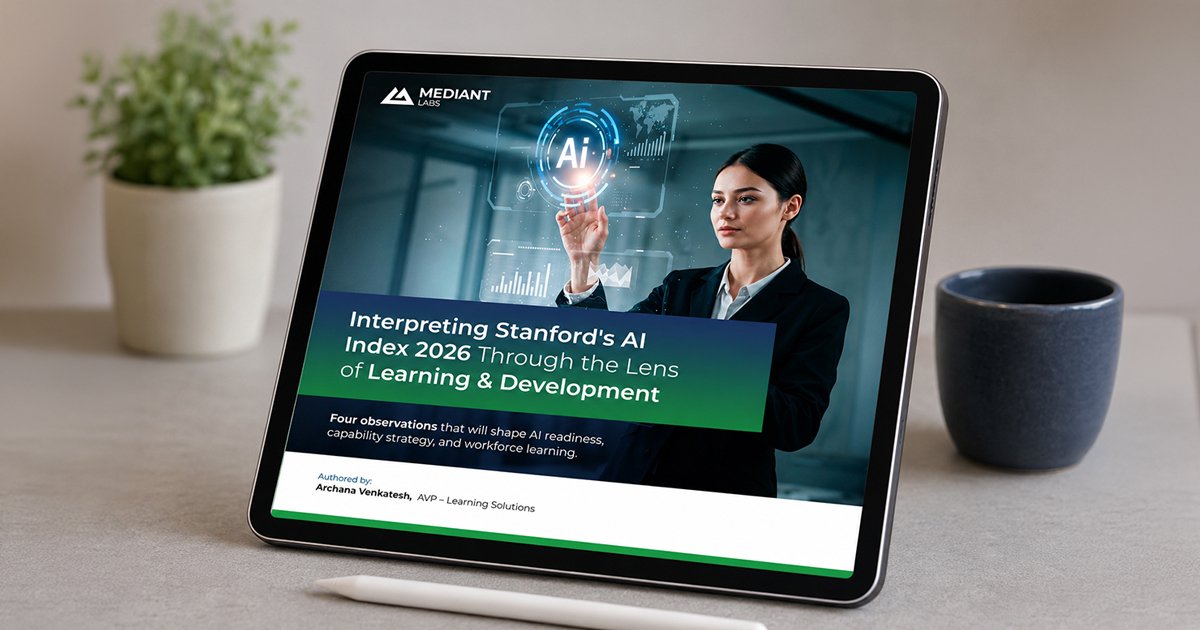
That was the starting point for Mediant Labs’ latest editorial brief, Interpreting Stanford’s AI Index 2026 Through the Lens of Learning & Development. The brief looks beyond what AI can do to ask a more consequential question: What does the evidence mean for the people responsible for building capability?
And some of the implications are not particularly comfortable.
The AI conversation is becoming a capability conversation
AI adoption is often discussed in terms of tools, productivity and readiness. The AI Index points to something broader: organizations are changing the systems through which people work, learn, make decisions and develop expertise.
The editorial brief draws out four observations that deserve a closer look:
- Responsible AI involves trade-offs that organizations may not always recognize.
- The foundational work through which professionals develop expertise is beginning to change.
- Greater AI performance does not necessarily mean greater transparency.
- Governance structures are expanding faster than the capability required to make them work.
Each observation has a direct implication for L&D. Together, they suggest that AI readiness cannot be reduced to training people on new tools.
What happens when the bottom rungs of the career ladder get shorter?
Consider the work traditionally assigned to people early in their careers. It may look routine, but it often provides the repetition, feedback, and challenge through which professional judgment develops.
The compression is happening precisely where AI’s productivity gains are strongest. That raises a question well beyond software development: if AI absorbs the work through which expertise traditionally develops, where will that expertise develop next? It’s a question that could reshape onboarding, graduate programs, career pathways, and capability frameworks.
Better AI performance. Less visibility?
Another finding deserves attention. Transparency scores for foundation models fell from 58 to 40 between 2024 and 2025, after improving the previous year — while capability benchmarks continue to be widely reported and responsible AI benchmarks remain limited and largely voluntary.
If the underlying model is difficult to interrogate, accountability does not disappear. It moves closer to the people deploying the system.
For L&D leaders, this is more than a technology concern. What happens when an AI-powered learning pathway recommends the wrong content? Or when an AI assessment misdiagnoses a capability gap?
And then there is governance
Organizations are putting more structure around AI. AI-specific governance roles grew by 17% in 2025, and the proportion of businesses operating without a responsible AI policy fell from 24% to 11%. Yet the most frequently cited implementation barrier was not technology.
That distinction matters. A policy is not the same as capability. A governance role is not the same as judgment. And compliance training alone cannot equip people to question AI outputs, interpret uncertainty, or understand the trade-offs embedded in AI-enabled systems.
Four observations. A bigger question for L&D.
The full editorial brief brings these threads together to make a broader case: AI is changing work, but L&D has a role in determining how people change with it.
THE OPPORTUNITY
Not simply to create more AI learning programs — but to rethink how organizations build judgment, develop expertise, support performance, and prepare people to work responsibly alongside increasingly capable systems.
The brief doesn’t attempt to provide definitive answers. Instead, it asks better questions — and that may be the more useful place for L&D leaders to start.
Get the full editorial brief
Explore all four observations, the evidence behind them, and what they could mean for your organization’s AI readiness and capability strategy.
Download the Brief