TL;DR: AI closes the gap between training completion and on-the-job behavior change by continuously measuring what employees actually do, delivering targeted interventions to the right person at the right moment, and tying learning to measurable business outcomes. For enterprise L&D teams, the six highest-value applications are adoption analytics, stakeholder segmentation, personalized communications, microlearning nudges, predictive adoption models, and manager coaching prompts.
Why does traditional L&D fall short?
L&D teams face a well-documented gap: the distance between training completion and actual behavior change. A sales team can finish every CRM onboarding module and revert to spreadsheets by week three. A finance team can complete a process redesign workshop and quietly rebuild the old workaround within a month.
Conventional L&D programs follow a familiar arc: kick-off communications, a training event, a manager briefing, then silence. Leaders look at completion rates and declare success, but completion rates and seat time are vanity metrics, not evidence of behavior change. The structural problem is that traditional approaches generate no signal after the event, so L&D teams operate blind.
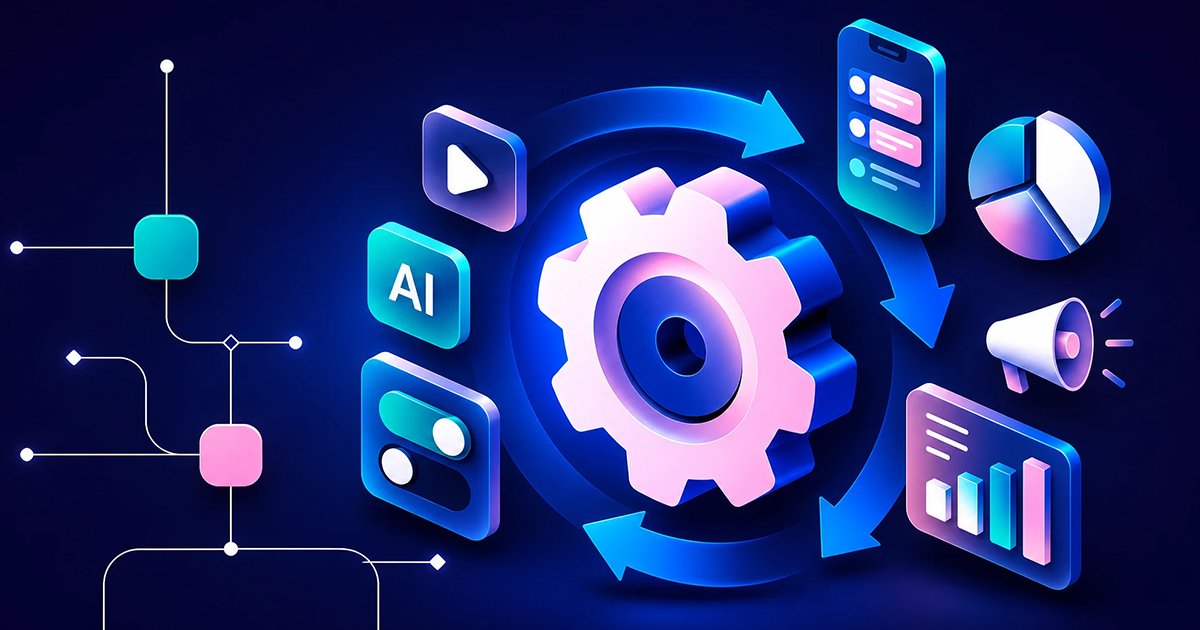
AI replaces that static model with a continuous feedback loop: instrument the workflows employees are supposed to adopt, detect behavioral signals indicating proficiency or resistance, generate targeted interventions for the right segment at the right moment, and measure behavior change against defined outcomes. This matters most in four scenarios: fragmented learning ecosystems where training data sits in an LMS and usage data in a CRM; global rollouts where centralized teams can’t support every region; stretched L&D teams that can’t personalize at scale; and executive pressure for ROI rather than anecdotes.
What are the top AI use cases for L&D workflows?
1. Adoption analytics
Instrument target systems to generate behavioral signals. If you’re migrating the sales org to a new CRM pipeline, the telemetry question is whether reps actually log calls, update stages, and follow the workflow. AI analyzes usage logs against the defined “success behavior” profile to calculate a live adoption rate per user, team, and region.
2. Stakeholder segmentation
Not every employee is in the same situation. Role, process ownership, proficiency, and resistance likelihood all vary. AI groups individuals by these factors so interventions aren’t generic. A regional director comfortable with CRM data entry needs a different nudge than a field rep avoiding the system entirely.
3. Personalized change communications
Once segments are defined, communications adapt dynamically. An employee who completed training but shows low usage gets a different message than one actively using the tool but making consistent errors. AI selects the right variant, channel, and timing for each behavioral profile.
4. Microlearning nudges
Context-timed interventions delivered at the moment of need. If a user fails a process step three consecutive times, the system surfaces a 90-second job aid rather than waiting for a support ticket. Timing is what makes nudges effective.
5. Predictive adoption models
Early behavioral signals forecast which users or teams are at risk. Inputs include login frequency, error rates, workflow completion, and peer comparison. The output is a risk score that triggers pre-emptive intervention before non-adoption becomes habitual.
6. Manager coaching prompts
Managers reinforce new behaviors but aren’t always equipped to. AI analyzes team-level data and generates specific prompts: “Three team members haven’t completed the pipeline update in two weeks. Here’s a talking point for your next one-on-one.” This extends the L&D team’s reach without headcount.
Implementing AI in L&D workflows
Assess
Map the current state: target workflows, where data lives, and what “successful adoption” means as observable behavior. Produce a workflow map, a data source inventory (LMS/LXP, HRIS, CRM, ITSM, telemetry), a stakeholder map, and success-behavior definitions per role.
Design
Define the intervention architecture: which segments receive which interventions, what triggers each, and how attribution works. Build the measurement model (baselines, targets), and the governance and consent model. Employees need to understand what’s measured and why; transparency directly affects adoption.
Pilot
Run a limited rollout with one or two segments to validate prediction models, test integrations, and calibrate nudge timing. Track a weekly scorecard: behavior adoption rate, nudge engagement, prediction accuracy, and integration uptime.
Scale
Expand to additional teams, geographies, and processes with validated models and clean integration. Automate generation within guardrails, launch executive dashboards, and move governance reviews to a quarterly cadence.
What does AI for L&D workflows look like in practice?
An enterprise deploys a new CRM pipeline across 800 reps and 60 enablement professionals in four regions. Traditionally: a two-day virtual training, an email from the VP, and adoption measured by completion rates.
AI-enabled, it runs differently. The team instruments the CRM for step-level telemetry and establishes a 30-day baseline. HRIS and CRM data segments reps into four groups with differentiated plans. In week two, the AI layer detects one region systematically skipping the “close date” field and sends that cohort a targeted 90-second walkthrough. By week three, predictive risk scoring flags 47 reps for manager coaching prompts. Leadership receives a weekly scorecard showing adoption by segment and TTP trajectory, well before the change window closes.
Expected outcomes
Compared with training-only rollouts, an AI-enabled adoption program shortens time-to-proficiency and drives a higher rate of sustained behavior change.
What Mediant Labs delivers: the current-state assessment, stakeholder segmentation and intervention playbook, governance documentation, a live pilot scorecard, and the scale roadmap. The engagement runs through the measurement cycle to produce evidence of behavior change, not just evidence that training happened.