
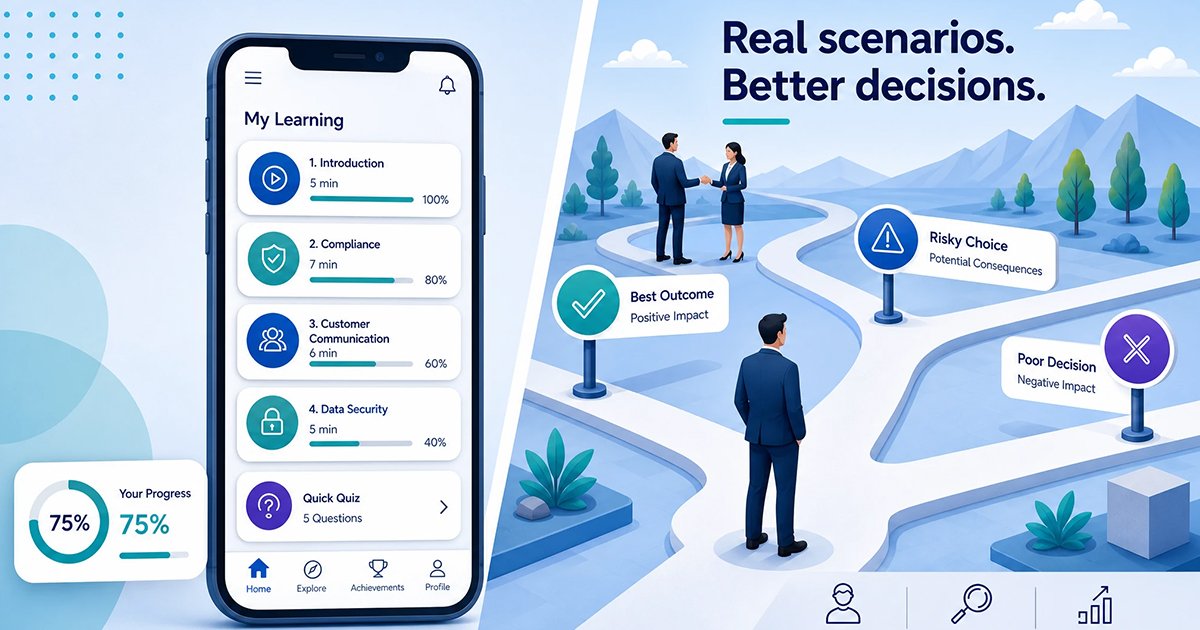
Slow competency costs real money. Every week a new hire can’t handle escalations independently, every quarter a sales team misapplies a revised process, every compliance cycle that produces rework, those are measurable losses in SLA performance, quality, and throughput. The question isn’t whether to close skill gaps faster. It’s which learning design actually works.
Two approaches, used together, consistently outperform everything else: microlearning to close skill gaps quickly with targeted knowledge, and scenario-based training for skill gaps that require judgment, not just recall.
Here are 7 proven ways companies combine them to drive faster upskilling.
1. Map competencies before designing a single lesson
Training content spans a wide range of asset types: eLearning modules, vILT decks, microlearning sequences, video-based lessons, scenario-based assessments, instructor guides, and performance support tools. Each has different localization requirements. A SCORM package has variables and branching logic that must survive translation intact. A video scenario has cultural nuance that a word-for-word translation destroys.
Without a repeatable enterprise training localization workflow, three failure modes appear consistently: terminology drift (the same concept described differently across 12 language variants), broken interactivity (untranslated UI labels or character-encoding errors that stop quiz scoring), and behavioral misalignment (scenarios that don’t reflect local workplace norms or regulatory expectations).
Mediant Labs practice
Our strategic consulting practice treats competency mapping as the non-negotiable first phase of any microlearning or scenario build.
2. Use microlearning for targeted knowledge transfer (3-7 minutes, no more)
According to Konstantly’s 2026 microlearning guide, the optimal microlesson length is 3-7 minutes per module, with a hard ceiling of 10 minutes. The ATD defines microlearning as “a training approach that delivers focused, bite-sized learning content in short bursts to help people quickly learn and apply a specific skill or concept.” One objective per lesson. One active recall check at the end. That’s the standard. Longer modules dilute focus and inflate time-to-competency, the metric you’re actually trying to move.
3. Schedule spaced reinforcement, not a single push
A single lesson, however well designed, fades within days without reinforcement. Current learning-measurement guidance recommends distributing microlearning reinforcement at set intervals after initial learning:
Recommended reinforcement cadence:
1. 24 hours after initial learning
2. 3 days after initial learning
3. 1 week after initial learning
4. 1 month after initial learning
This spaced reinforcement schedule is what converts short-term recall into durable retention. Build the spacing cadence into the LMS path as a designed element, not an afterthought. Mediant Labs’ learning administration practice handles exactly this kind of sequenced deployment for enterprise cohorts.
4. Follow microlessons with branching scenarios that force a decision
Once a learner has the knowledge, they need to apply it under pressure. Branching scenarios in corporate training place learners in realistic, high-stakes contexts where every choice leads to a consequence. Research published in Emerald (September 2025) describes branching scenario designs as creating “safe, feedback-rich environments” that facilitate “experiential learning without real-world consequences.” A customer support rep who reads about de-escalation techniques and then practices them in a branching scenario retains more and transfers faster than one who only completed the microlesson.
5. Match scenario fidelity to the actual decision environment
Low-stakes scenarios for high-stakes decisions produce false confidence. The fidelity of a scenario, the realism of its context, the pressure of its constraints, the specificity of its feedback, must match what the learner faces on the job. Role-play training for workplace skills like manager coaching conversations requires full dialogue trees with emotional context. Simulation training for decision-making in technical or clinical environments needs accurate system states and failure consequences. The feedback after each decision is the real teacher: it must explain why a choice is correct or incorrect, not just flag it.
6. Measure time-to-competency and 30/90-day retention, not just completions
Completion rates tell you who clicked through. They don’t tell you who can actually do the job. The right learning KPI evaluation plan tracks three things:
| Metric | What it measures |
|---|---|
| Time-to-competency | Days from enrolment to passing a validated assessment at a defined proficiency threshold |
| 30-day retention | A delayed check to confirm knowledge hasn’t degraded |
| 90-day retention | A second check, paired with manager or supervisor observation of on-the-job behavior |
Scenarios drive the behavioral transfer signals. Microlearning with spaced reinforcement drives the retention curve. Both are required to move all three KPIs.
7. Run a structured pilot before scaling
The fastest way to validate a microlearning + scenario program is a time-boxed pilot. Map one competency, build 3-5 microlessons with the spaced reinforcement schedule, add 1-2 branching scenarios, deploy to a cohort of 20-50 learners, and measure against a baseline. You’ll have time-to-competency data and 30-day retention scores before committing to full-scale production. Mediant Labs offers this as a structured engagement through its learning execution model: competency mapping, content build, LMS deployment, and a KPI scorecard with a scale recommendation.
The combination of microlearning and scenario-based training works because each format solves a different problem. Microlearning delivers and reinforces the right knowledge. Scenarios test whether learners can apply that knowledge under realistic pressure. Measurement tracks whether any of it transfers to the job. Miss one of those three and you’ll see completions rise while skill gaps stay open.
If you’re ready to compress ramp time and build a measurable learning program, connect with Mediant Labs to start with a discovery session.